Category
infrastructure
Written by


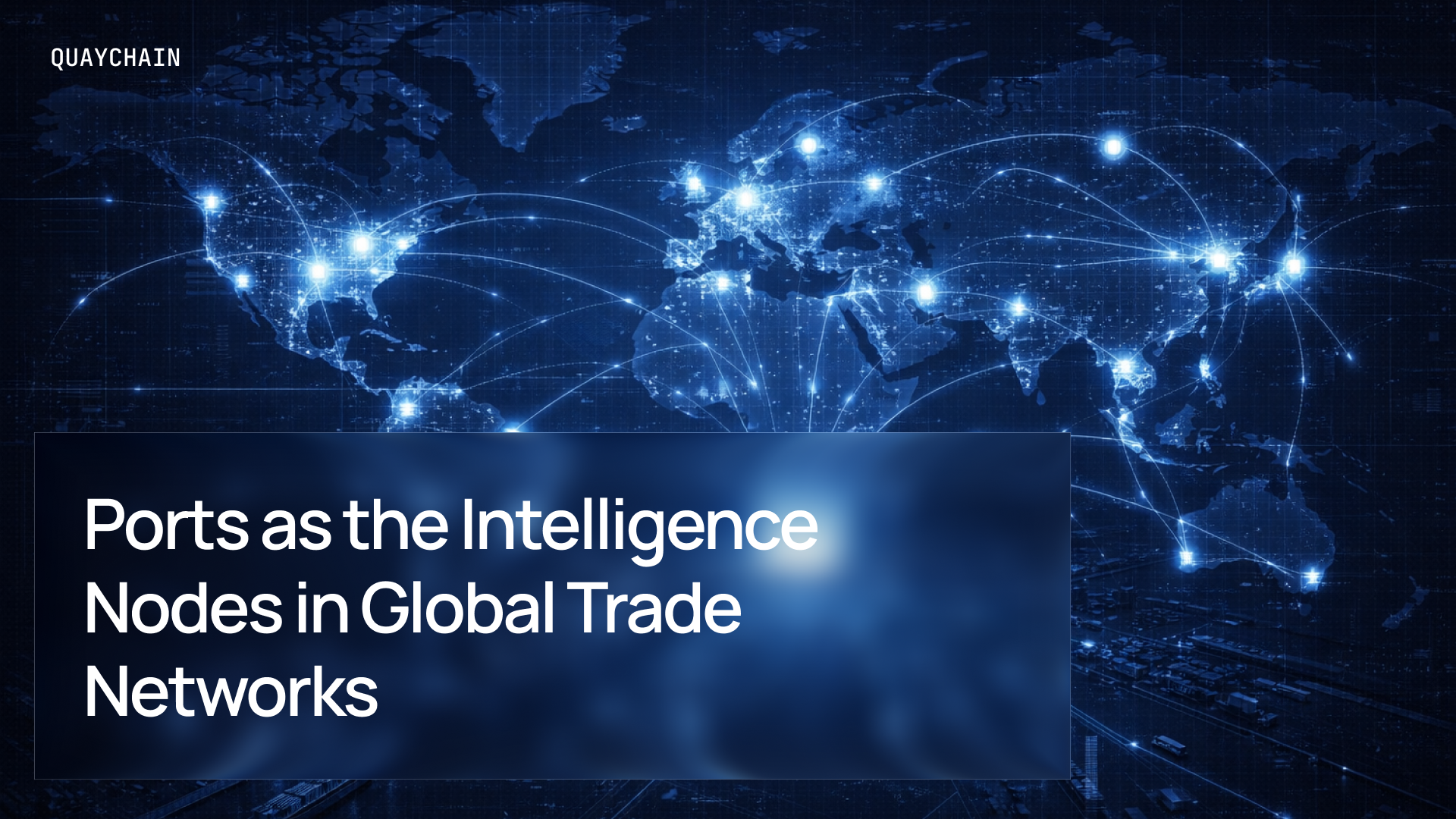
Ports have traditionally been understood as physical gateways within global trade.
They sit at the intersection of maritime routes, inland logistics, customs systems, labor coordination, and infrastructure capacity. Their strategic importance has historically been measured through location, berth availability, vessel volume, hinterland access, and the scale of trade flows moving through them.
Those factors still matter. But they no longer capture the full strategic role ports are beginning to play inside modern supply chains.
Ports are becoming intelligence nodes in global trade networks.
This shift matters because it changes how ports should be evaluated by investors, operators, policymakers, and supply chain leaders. The port is no longer simply a place where cargo moves through infrastructure. It is increasingly a place where operational signals converge, disruption becomes visible, decisions are coordinated, and network conditions can be interpreted in real time.
In practical terms, the role of the port is expanding from throughput management to network intelligence.
The traditional view of a port emphasizes physical movement. Cargo arrives, is unloaded, staged, transferred, processed, and moved onward through truck, rail, barge, or warehouse networks. In this model, the primary question is how efficiently the asset handles cargo volume.
That remains a core operational objective, but it is no longer sufficient in a more volatile trading environment.
Modern trade networks are shaped by schedule instability, inland congestion, fragmented data, labor constraints, equipment bottlenecks, weather disruptions, geopolitical risk, and shifting customer requirements. As a result, port performance is no longer determined solely by how much cargo can be handled. It is increasingly determined by how effectively the port can see, interpret, and coordinate around changing conditions.
That is where the traditional model begins to break down.
A port may have substantial physical capacity and still underperform if decision making is slow, stakeholder coordination is weak, or operational visibility is fragmented across the marine, terminal, yard, gate, and inland layers of the logistics network.
In that environment, the port cannot be understood purely as a static infrastructure asset. It must be viewed as an information rich coordination point inside the wider trade system.
Ports occupy a uniquely valuable position inside global logistics networks.
They are one of the few environments where multiple layers of operational reality converge simultaneously. Vessel schedules, terminal operations, truck flows, rail timing, yard conditions, customs activity, labor readiness, inland constraints, and customer service commitments all intersect around the port environment.
That concentration makes the port a natural intelligence node.
If the port can capture and interpret signals across these layers, it can do more than process throughput. It can improve planning quality, identify bottlenecks earlier, coordinate around disruption, and create better visibility for both local operations and the broader supply chain network.
This is strategically significant because many supply chain disruptions do not begin as system wide crises. They often start as local coordination failures that go undetected until they cascade into wider network problems.
Ports that can detect these conditions early and respond with discipline become more valuable than their throughput numbers alone would suggest.
Once a port functions as an intelligence node, several aspects of asset performance begin to change.
Operational responsiveness improves.
A port with stronger signal visibility across vessel arrivals, yard pressure, gate conditions, labor allocation, and inland handoffs can adapt faster when conditions change. This reduces the lag between disruption and response, which is often where avoidable delays become structurally expensive.
Coordination quality improves.
Ports operate in complex multi party environments. Terminal operators, carriers, trucking networks, rail partners, customs agencies, labor groups, public authorities, and cargo owners all influence performance. Intelligence matters because it creates a shared operational picture that can support stronger coordination across those groups.
Infrastructure planning becomes more disciplined.
When operational data is stronger, the port is better positioned to identify where capacity is genuinely constrained and where performance loss is being driven by coordination failures. That distinction matters because it affects capital allocation decisions.
Finally, the port becomes more strategically valuable to the surrounding logistics ecosystem.
The stronger the intelligence layer around the port, the more useful that asset becomes not only to terminal operations but also to freight planning, inland distribution, network resilience, and regional supply chain decision making.
This transformation does not happen because a port installs more dashboards or software.
It happens when the port builds a control layer capable of turning fragmented operational signals into coordinated action.
That control layer may include:
• real time awareness of marine, yard, gate, and inland conditions
• stronger exception management across stakeholders
• clearer escalation pathways when schedules move off plan
• better integration between physical infrastructure and operating systems
• more disciplined use of operational data inside control room decisions
The presence of data alone is not enough. The key question is whether the port can use that information to improve timing, prioritization, recovery, and coordination under real operating conditions.
That is what makes the intelligence layer strategically relevant.
For investors, this shift means ports should not be evaluated purely on physical attributes.
Location, draft depth, inland access, and capacity will always matter. But future performance differences between ports will increasingly be shaped by the quality of the intelligence and coordination layer surrounding the asset.
A port with strong geography but weak coordination capability may ultimately prove less defensible than a comparable asset with stronger operational intelligence and stakeholder integration.
Investors should therefore ask several key questions:
• How effectively can the port see across operational handoffs?
• How quickly can management respond when conditions change?
• How disciplined is coordination across marine, terminal, gate, and inland layers?
• Can the port distinguish between capacity constraints and coordination failures?
• Is the port becoming more central to regional supply chain decision making?
These are not abstract technology questions. They are questions about infrastructure quality in a more complex logistics environment.
Ports are no longer just physical gateways inside global trade.
They are becoming intelligence nodes that help the wider network interpret conditions, coordinate around disruption, and improve operational decision making.
This shift does not reduce the importance of physical infrastructure. Instead, it increases the importance of the intelligence layer wrapped around it.
For investors and infrastructure owners, port quality should increasingly be judged not only by asset capacity and location but by the port’s ability to function as a control point inside a more complex and data intensive logistics system.
That distinction will likely become one of the defining differences between average port assets and strategically important ones over the next decade.